
Open vision and engineering hypothesis · edition
Stage one: collect our own data
According to the team, an operation-level digital model and web-based Planner already exist. Statuses cover planned, accepted by a crew, in progress, paused or blocked, quality review, rework and quality accepted. Acceptance requires a checklist and video report.
This is partial digitization, not a completed autonomous factory. Record completeness, update discipline, procurement and warehouse integration, and measured economic impact still need verification. Robotic production and proprietary AGI are not operational.
The immediate goal: one standard home with a complete history of materials, execution, inspection, rework and handover. First prove this journey works; then scale it.
From AI assistant to manufacturing operating system
AI can already assist with project cards, status analysis, finding missing records, workload calculations from supplied data and sequencing proposals. Actions in the Planner require access and agreed authority. Having an interface does not prove autonomous control of an entire factory.
The goal is to automate routine production-management functions: material and resource balancing, operation dependencies, dispatching, exception handling and replanning with visible consequences. AI has not fully replaced that role today: without reliable facts, operational authority and verified safety, such a claim would be untrue.
The experience of current crews is a valuable source of skill demonstrations for future robots. We record action sequences, tools, parameters, errors and accepted outcomes — not people as raw material. Participation rules, recording rights, de-identification, worker protection and a transition plan for new roles are required. The long-term goal is replacing manual execution with robots; we are not there yet.
One digital journey. Nine connected blocks.
This is the target architecture. The website, CRM, Planner, warehouse and robots are not being presented as already integrated. Each connection needs its own permission, data and outcome checks.
- Conversation and orderThe AI assistant clarifies needs, explains specifications and guides a showroom visit. In the future an approved order reaches manufacturing through a validated contract, not an arbitrary LLM command.
- Project and digital twinModel version, 3.5 × 7.5 m modules, 2.6 × 7.5 m terrace, bill of materials, cost estimate, dependencies and acceptance criteria. One project_id throughout.
- Materials and warehouseBatch, serial number, supplier, incoming inspection, storage location, reservation, issue, returns and stock. Barcode scanning first; robotic picking later.
- Crews and executionSkills, availability, shift, operation, actual start and finish, pauses, blockers and material consumption. AI proposes a plan; policy defines who can change it.
- Quality and learning examplesChecklist, measurements, operation-specific images or video, defect, rework and reinspection. Accepted and rejected work remain distinct examples.
- Module separation and packingAfter fit checks: controlled module separation, connector identification, surface protection, weight, centre of gravity and an approved lifting plan.
- Loading and deliveryCargo identity, departure condition, securing, vehicle, route, agreed windows, ETA and handover events. Autonomous driving is a separate future regulatory and engineering stage.
- Unloading and installationVerified site readiness, foundations, crane access, weather, controlled work area, placement, joints and sealing. Field robotics requires separate testing.
- Connections and livingUtility and autonomy-system tests, specialist acceptance, home passport, warranty boundaries and service. Occupied-home telemetry requires separate consent.
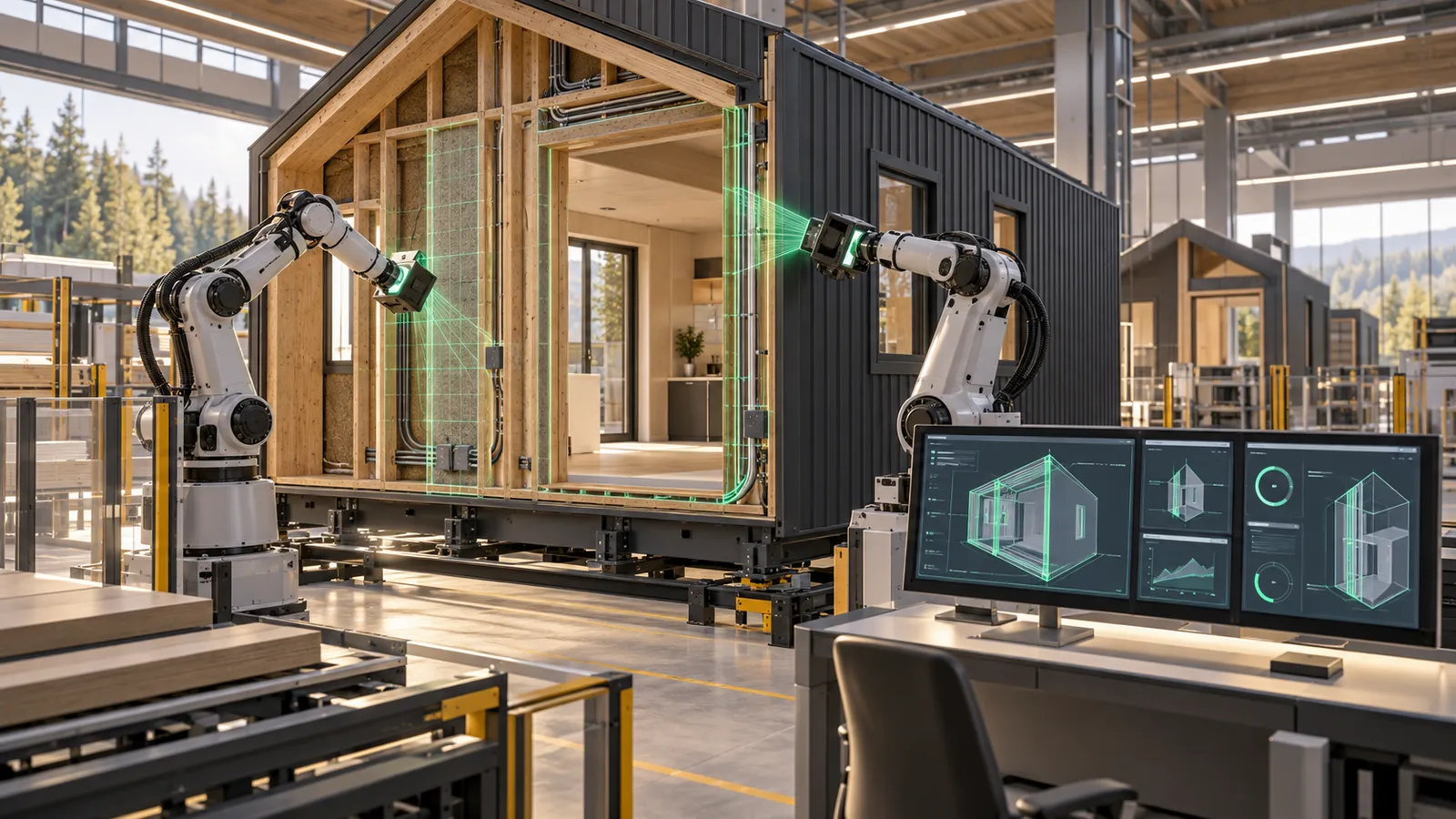
Billions of signals are not billions of insights
Illustrative arithmetic, not our installed equipment: 8 cameras × 3840 × 2160 pixels × 30 frames/s = 1.99 billion pixels per second. Uncompressed RGB is approximately 5.97 GB/s, or 516 TB/day before overhead. A pixel is not a training example or a verified manufacturing event.
Intensity should mean usefulness: local edge processing, short event clips, sampling, features, annotation-quality checks and deletion schedules. We do not plan to stream all footage to the cloud indiscriminately or retain it forever.
Minimum event: event_id, UTC timestamp, source, project_id, module_id, operation_id, material batch, drawing version, state, unit, value, signal quality, evidence reference, permitted role and retention policy. Idempotency, clock synchronization and an audit trail are essential.
First measures: operations with complete actuals, update delay, checklist coverage, rework, inventory accuracy and completeness of material-to-module-to-home traceability. Targets follow a baseline measurement; current values are unknown.
Proprietary intelligence begins with proprietary context
First: our knowledge base, versioned process instructions, protected CRM memory and response-quality evaluations. Next: specialized prediction, computer-vision and robotics models trained or adapted on lawfully obtained data. RAG and chatbot memory are not AGI training.
The long-term research ambition is proprietary AGI capable of coordinating the complete manufacturing system. ModulDim has no such system today; its feasibility, cost and delivery date are unproven. Practical milestones should neither wait for nor depend on AGI.
Our advantage must be verifiable: distinctive process data, rights to use it, reproducible tests and better customer outcomes. Buyer contacts do not become training data by default.
Stages gated by evidence, not promised dates
The intervals below are scenarios after funding, staffing and a baseline are agreed, not an approved budget or guarantee. Each stage opens only after the previous one passes acceptance.
01 · Data and discipline
First 0–3 months after resources are approved: shared identifiers, sources, permissions and status rules; an end-to-end history of one home. Exit: reproducible fact audit, not the number of cameras installed.
02 · AI dispatcher
Indicatively 3–9 months: blocker and workload forecasts, planning proposals, CRM and inventory. Start in shadow mode alongside people. Exit: predictions compared with actuals and approved rights for narrow actions.
03 · One robotic cell
Indicatively 9–18 months: one repeatable safe operation, fixtures, expert demonstrations, simulation, quality checks and independent acceptance. Exit: safety, stable quality and economics across real cycles.
04 · Connected manufacturing
Indicatively 18–36+ months: warehouse robots, multiple cells, automatic transfer and inspection. Exit: verified transition reliability, fault recovery and tested manual intervention.
05 · Factory to plot
Undated research horizon: packing, transport, lifting, installation and testing in changing environments. Separate approvals, insurance, weather limits and safe stopping for each process.
06 · Robots perform 100% of direct execution
Ultimate hypothesis: people no longer perform routine physical or dispatching work. This does not remove ownership, legal accountability, independent inspection, emergency intervention or the customer’s right to contact a human.
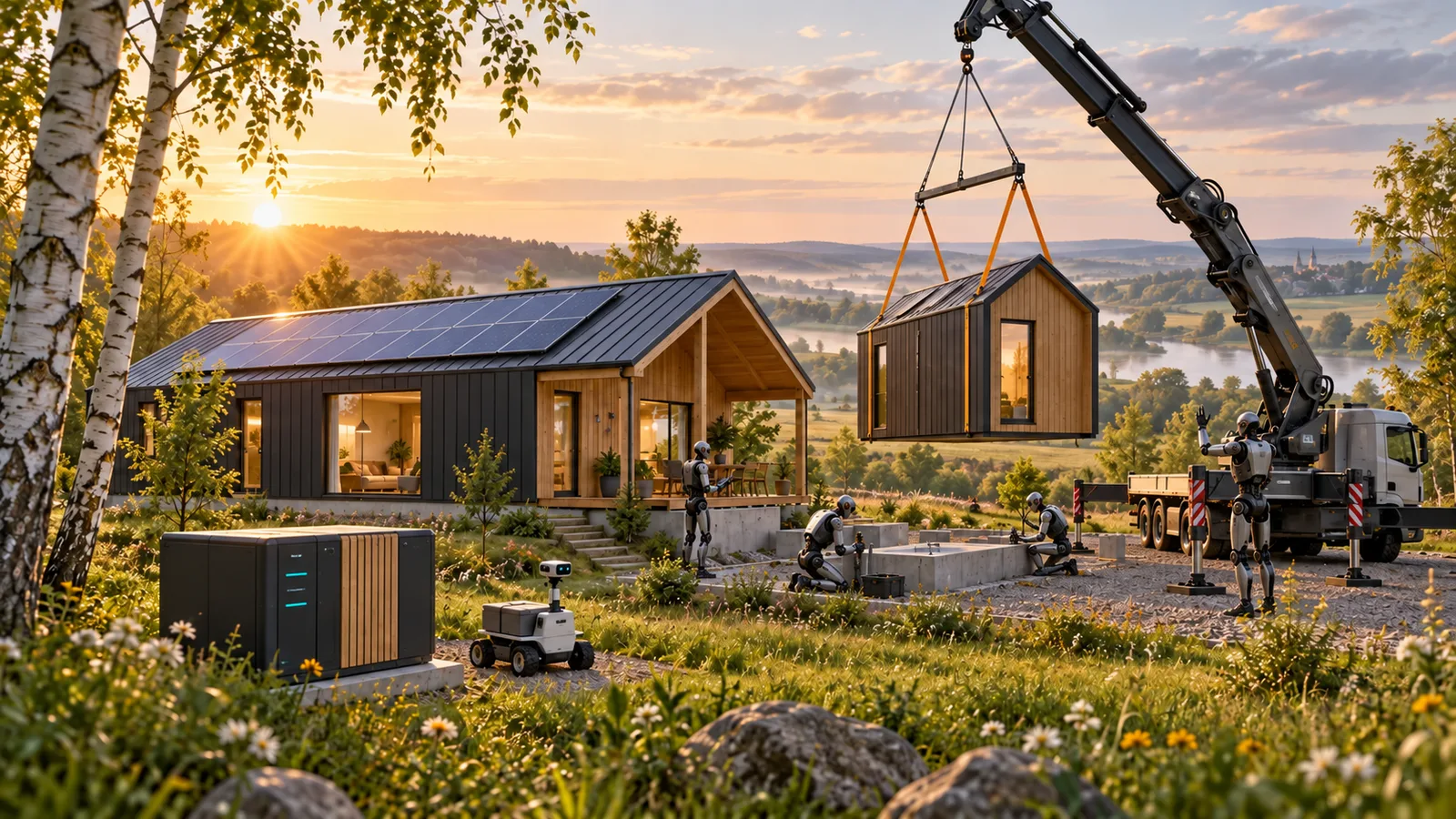
Chinese manufacturing: what already exists
Primary sources checked on 23 September 2026. These are architecture references, not ModulDim partners or evidence that their performance transfers to construction. A fully robotic operation, workshop and complete lifecycle are different claims.
Xiaomi · Beijing Auto Factory
100% automation of key body-shop processes and 91% overall, according to the manufacturer. Not 100% of all work from ordering to service.
NIO F2 · 22.06.2026
NIO reports F2 joining the Global Lighthouse Network and AI-supported decisions in around 80% of manufacturing scenarios. The lesson is digital twins and closed feedback loops, not proof of AGI.
ABB · Shanghai Mega Factory
Robots manufacture robots in flexible cells with digital planning and autonomous movement. ABB also describes people’s roles; we do not label the entire value chain human-free.
ABB · new robot families, 02.07.2025
The manufacturer confirms new robot families produced at the Shanghai factory. Relevant operations include material handling, assembly, dispensing and polishing.
One AI assistant. Our own data system.
The first software layer: approved knowledge → AI conversation → protected lead record → our own calendar → confirmed slot → concise team notification. Contacts are entered separately from model context. Conversation memory and CRM live in encrypted server storage outside the public website.
Approved showroom hours: daily 08:00–20:00 Kyiv time, 30-minute visits, initially one manager. The calendar reserves free slots atomically; the manager list expands through configuration. Telegram bot: @ModulDimBot. Live AI and notifications require server credentials and integration verification.
Telephony and other messengers are the next adapters to the same system, not channels already connected. Voice requires a provider, number, disclosure rules and separate testing. Cross-channel identities merge only through a verified link, never a similar name.
A bright future with verifiable boundaries
The LLM gets no direct access to cranes, electrical panels, robots or bank accounts. Model suggestions reach physical actions only through permission checks, deterministic controllers, constraints, logging and safe stopping. We publish approved aggregates and evidence; private conversations, contacts, secrets and raw worker recordings are not public content.
Six-month target after funding
The month-six target is end-to-end production-cycle management through a proprietary AI system: orders, specifications, materials, crew scheduling, operations, quality control, cost and handover. Dmytro Arkas develops and implements it. Authorised humans remain accountable for safety, release, payments and exceptions, with decision logs and manual recovery. This is a target capability, not the current state.
Within six months of funding: gradually grow from three to ten crews, display seven models with terraces, and reach ten manufactured and ten client-accepted, habitable homes per month by the end of month six. These are targets, not achieved results. Showroom homes are sold and replaced; they must not be counted twice in output or sales.