Who it is for
Families with their own plot who need a habitable home quickly. We are still validating this initial segment.
Project document · AltaLab · partners · investors
How ModulDim is moving towards standard-design housing with predictable delivery, quality and economics. What already exists, what we are implementing and what still needs to be proven.
Building in public: researching the market, testing hypotheses and sharing what we learn. Read and share the materials without a password. Facts, plans and verified results are kept separate.
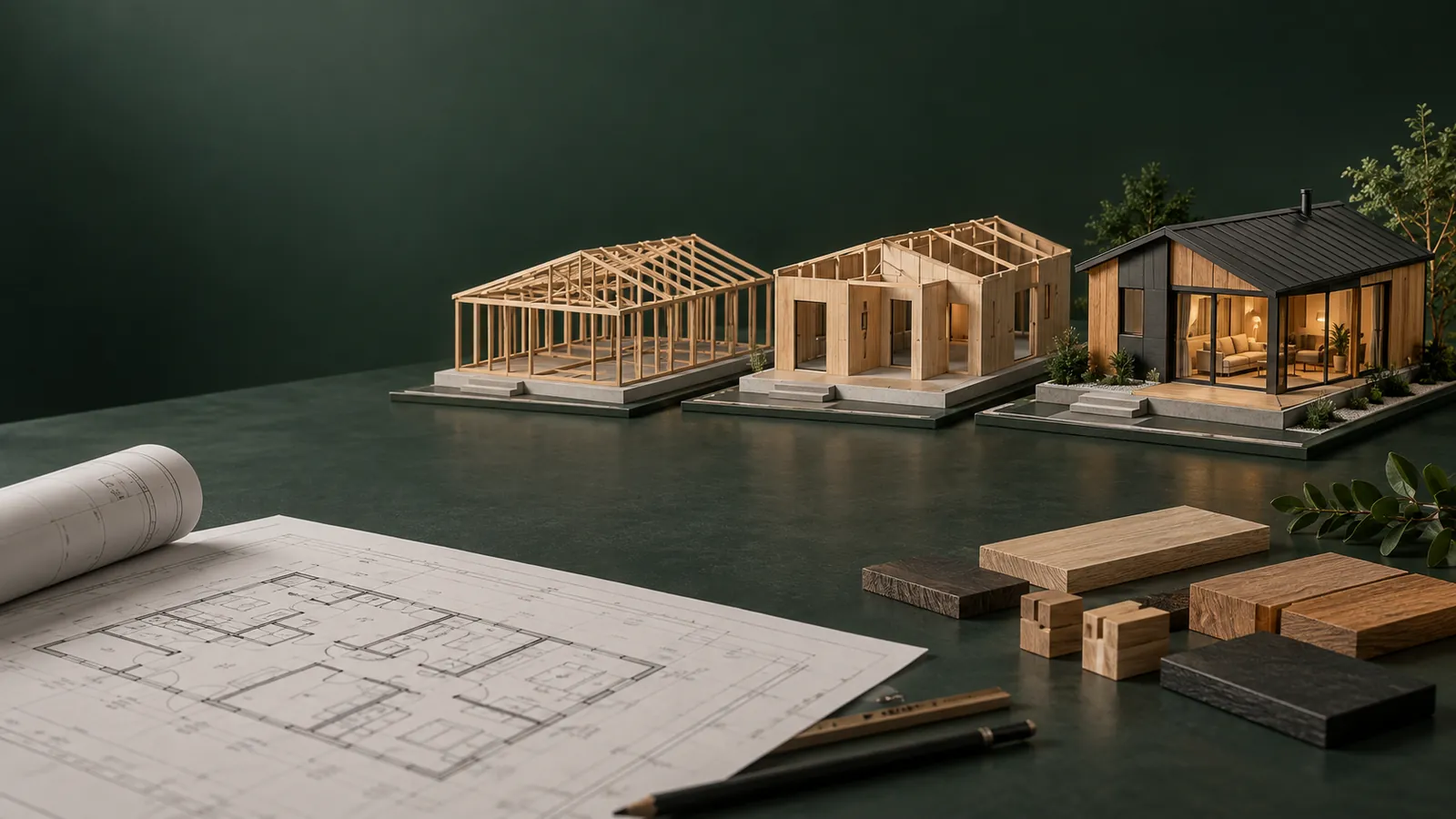
Conceptual AI visualization: from drawing to home. Not a production photograph.
Target model · not a claim of achieved performance
Families with their own plot who need a habitable home quickly. We are still validating this initial segment.
A standard-design home with an agreed specification. The full budget, site readiness and timing are defined for each order.
Connecting people, materials, execution and quality in a digital workflow. Data completeness and repeatable results are the next things to verify.
Handover on agreed terms, actual unit economics and the ability to repeat the result with another team. AI impact is evaluated separately.
Three views of the same model: opportunities and risks, business logic and a concise project story. Preparing these documents does not complete validation.
ROADMAP · FROM PROMISE TO A HOME FIT FOR LIVING
Seven stages towards one customer outcome. The direction is agreed; specific people, resources and the handover date still need confirmation. Autonomy, Parks and robotics are not prerequisites for the first handover.
Pilot protocol and supporting measures → · Weekly review →
PRIMARY METRIC · SHARED OUTCOME
The actual baseline has not yet been reconciled. Missing data does not mean zero. The immediate goal is the first confirmed handover; one case does not establish repeatability.
Count each distinct standard-design home once, on the date when customer handover, acceptance and fitness for living are all confirmed. Evidence must include an acceptance record, an installation and necessary-connections checklist, system checks and no unresolved critical defects. A signature or shipment alone is insufficient; if readiness is confirmed later, count the home on that later date.
Weekly review: a calendar week, Monday–Sunday, in Kyiv time; label an incomplete current week. Monthly totals use calendar months without counting any home twice. Track the Kyiv and Kyiv-region pilot separately from the company as a whole.
Alongside handover counts, report delays against the originally agreed date, open defects and outstanding obligations. Check full order economics separately: incomplete costs are not evidence of profitability. A late but usable handover counts towards the outcome and remains recorded as late.
Sales and production completion run in parallel. Preliminary site checks and cost recording start immediately. A contract, deposit, factory readiness and shipment are intermediate events, not increases in the primary metric.
Update, 5 October 2026: the team reports prepaid orders occupying production until spring 2027, including the first order for the new range. Mass acquisition promising rapid handover has no verified production capacity behind it. T0 on 28 October 2026, reviews on 25 November and 9 December, and the 50/50 split are previous plans, not current launch approval. A new calendar and budget require verified available slots, lead times and quality; there is no automatic postponement to spring.
Before paid traffic and new contractual promises; date follows a production-queue review
Verify the specification and remaining work; define fitness-for-living criteria, the house price, additional costs and how to estimate them. Name the end-to-end coordinator and the change-approval process.
Accountability: Sales managers and the financial director within their respective responsibilities; management must agree the handover coordinator and authority.
Stage complete when: The offer specification, acceptance checklist, accountable people, resources and initial plan are agreed. Unknown costs and conditions are explicit; there are no unsupported guarantees.
Agree responsibilities and pilot start · Define the first home's offer · Agree how to protect pilot resources
Resume active acquisition after verifying capacity; previous November milestones are not current launch approval
Billboards and targeted online invitations → a direct visit or website, AI conversation and booking → an actual viewing. The ICP is a family that has decided to settle outside the city for permanent living; land ownership is not required. Check access and viewing arrangements before launch. Record the primary source, assisted touchpoints, verbatim trigger, needs, budget and decision participants separately.
Accountability: Development team: channel, AI and records; sales managers: the viewing and next step.
Stage complete when: Dated actual viewings by unique qualified households, excluding bookings, repeat visits and pre-campaign buyers. Track billboards and online acquisition separately and together without duplicates. Agree new numerical thresholds after the budget; the previous 5 visits and 10 families are historical learning guidelines, not achievements or a new guarantee.
Test demand through home viewings · Sales funnel and actual CAC dashboard
Parallel with sales from the start; agree the completion date after reviewing remaining work
Verify remaining operations, materials and worker availability. Complete the work, pass inspections and close rework. Retain every plan change with its reason and impact on other orders.
Accountability: Financial director: production completion; the pilot brief must specify workers, quality control and responsibility for maintaining the plan.
Stage complete when: Operations have passed checklist-based inspections with video reports; critical defects are closed and readiness for transport is confirmed. Factory readiness does not yet mean the home is fit for living on the customer's site.
First standard-design home · Acceptance checklist and video report · Complete data and a single plan
As of 2 October 2026: first contract signed, 50% advance received
As confirmed by the team as of 2 October 2026, the contract for the first standard-range home order has been signed and the 50% advance received. This is an order for a new similar home following a showroom viewing, not a sale of the display home. Full payment, site readiness and handover are tracked separately; the handover date is agreed under the contract.
Accountability: Sales managers; authorised people approve commitments and verify payment.
Stage complete when: A signed contract and receipt of the 50% advance are confirmed. Cancellations and refunds are tracked separately. This is paying demand, not yet a habitable home handed over. An order preceding the 28 October 2026 campaign is excluded from its buyers and CAC.
Confirm the first sale · Agree plot readiness and the handover plan
Preliminary check before the contract; final confirmation before shipment
Confirm the foundation, necessary utilities, access, crane space, transport, installers and connections. Separate the buyer's work from ModulDim's obligations and agree its cost.
Accountability: The handover coordinator, buyer and specialist contractors within their respective responsibilities; appointments still need agreement.
Stage complete when: Site readiness is verified, equipment and workers are confirmed, and the handover date and conditions are agreed. Do not ship to an unprepared site simply to improve the output figure.
On the agreed date for the specific order; not automatically within six weeks
Deliver and install the home, make the necessary connections and check systems with the customer. Resolve barriers to safe occupancy; provide instructions and a support contact.
Accountability: Handover coordinator and specialist contractors; acceptance by the customer and an authorised company representative.
Stage complete when: There is a customer acceptance record and dated fitness-for-living checklist with no unresolved critical defects. Count the home once in the primary metric; retain the date, delays and outstanding non-critical obligations.
Record costs from the start; conclude after handover and reconciliation of obligations
Compare planned and actual timings, costs, rework and customer outcomes. Identify what delayed handover, check post-handover defects and define changes before the next home.
Accountability: Accounting, production and sales; authorised management decides on the next launch.
Stage complete when: There is an anonymised case, a reconciled order result or explicit list of missing data, next actions and a decision: repeat, improve or pause expansion. New dates and commitments rely on confirmed resources, not just enquiry counts.
THE TEAM'S WEEKLY QUESTION
Each week, check the main obstacle across the whole journey: buyer, specification, funds, materials, workers, quality, site or logistics. Select one main obstacle and 3–5 actions to remove it. At the next review, check what actually happened, not just a new status. If the obstacle remains, agree a decision and its consequences for dates and other orders.
Review period and date | anonymised home ID | stage | usable homes handed over during the period or “data not reconciled” | main obstacle and evidence | action | owner | due date | original and current handover dates | actual result at the next review | decision.
This is a weekly review protocol, not a meeting already held or an automated reminder. Publish only approved anonymised findings; contacts, contracts, private videos and Planner data are not copied automatically.
A lesson on focus · our interpretation of AltaLab materials
Testing the standardized product requires agreed resources and explicit decisions about the consequences of changing priorities. Having a Planner does not provide this on its own.
A diverse order mix is not automatically a mistake: other business lines may support the company. Without examining their economics, there is no basis for declaring them unnecessary. We need to understand how they use shared people, time and resources.
Proposed principle: before accepting new work, identify who it will occupy, what it will delay and who approves that consequence.
This is a proposal for management agreement, not an announcement of a policy already implemented or the cancellation of other orders.
Agree how to protect pilot resources →AI-native Housing OS · proposed evaluation process
ModulDim is digitally transforming an existing manufacturing business. AI-native is a direction for Housing OS, not an already proven company characteristic. We start with one standardized-home project and one use case, not by automating the entire business.
Name the person responsible for keeping the plan current, the people recording actual events and the person approving changes. Agree a review frequency. Every change in priority or crew availability must be recorded in the Planner with its reason and impact on other work.
The stage is complete when the process is agreed and the records are verified, not when a document is written.
Complete data and a single plan →Using recorded cases, compare AI with conventional rules and manual analysis on the same data, without access to the eventual outcome. Algorithms check operation dependencies and resource constraints; AI can explain the risk and propose alternatives.
At this stage, recommendations do not change the production plan. Record the versions of input data, model and instructions.
AI evaluation requirements →Once prerequisites are accepted, run a limited test on one agreed project. A person approves the action and its consequences. Compare the recommendation with what happened: decision-preparation time, feasibility of options, false alerts and test costs.
The outcome is a decision to continue, revise or stop. One successful case does not prove repeatable value.
Product outcome evaluation →Illustrative example: an electrician becomes unavailable → the system identifies dependent work and schedule risk → proposes options that account for resources → an authorized person approves the consequences → the outcome is checked after execution. This is a test scenario, not a description of an operational feature.
Safety boundaries: if data is incomplete or stale, constraints are violated or approval is missing, the recommendation is not applied; the decision stays within the agreed manual process. Private production data is neither published nor sent to an external AI service without separate access approval.
Learning without unauthorized changes: outcomes add to the evaluation set. A new model or instruction is retested and approved; operating rules do not change automatically. A proprietary model and robotics are not prerequisites for this pilot.
Status: proposed plan awaiting agreement. Named owners, resources, schedule, sample, value thresholds and stop criteria have not yet been approved. Data and process preparation can begin now; launching the AI pilot remains dependent on data verification and handover of the first home. Sales and handover do not depend on AI readiness.
Current working picture
A task status is not a percentage of company readiness. “Done” does not mean “economic impact proven”.
Static revision. Automatic update checks require JavaScript.
As reported by the team on 5 October 2026, production is booked until spring 2027; the first paid standard-range order is also in the queue. A resourced commitments plan, a dedicated standard-range slot and measured labour requirements are needed. No new marketing-engine launch date has been set.
Updated:
A proposed next stage, not an instruction to hire, procure or launch advertising.
The $500,000 target and six-month outcomes are agreed as a plan. Prepare a cost-backed budget, 12-month cash flow and legal verification. Candidate research is complete; outreach and funding received are not confirmed.
Updated:
Adaptation of the AltaLab notes dated 26 September 2026. A preparation plan, not completed validation or investor approval.
Depends on: investment-memo
Verify analytics and Search Console access, a 28-day baseline, source attribution and household deduplication, test exclusions and a private log. The start date, named owners and measurement completeness are not yet confirmed.
Updated:
An approved protocol, not evidence of connected analytics or measured results.
Depends on: focus
Update, 5 October 2026: scaling acquisition depends on verified production capacity; previous dates are historical plans. Publish one useful article a week without registration or a product pitch, in both languages. D1 is the first actual article after measurement checks; its date is not set. The plan is published; the eight articles and results are still ahead.
Updated:
Qualitative research supports the hypothesis of useful content before choosing a manufacturer, not a traffic forecast or proven CAC.
Depends on: content-measurement capacity-gate
A no-registration budget checklist is available on the website, with model, terrace and plot-stage choices. The next step is a real written offer covering all costs and conditions. There is no completed all-in estimate or published actual case yet.
Updated:
An approved direction of work, not proven conversion or CAC improvement.
A question-preparation tool, not an automatic quote, enquiry or booking.
Depends on: offer
The family deciding to settle outside the city is described through its profile, trigger, measurable losses and buying authority. Three checks of “Is this exactly you?” with year-round residents are needed; no answers have been collected. The 2–4 week window, quantified losses and best customers' sources are unverified.
Updated:
A working profile based on development-team decisions and managers' observations; validation with three customers is still pending.
Depends on: focus
Update, 5 October 2026: scaling acquisition depends on verified production capacity; previous dates are historical plans. A 90-day focus on standard-range home viewings at the Kyiv–Odesa showroom. Instead of broad search advertising: 50% of the advertising budget for several approach billboards and 50% for targeted online invitations. The total is still being clarified; the earlier $500 belongs to a previous test. Initial T0 on 28 October 2026 and reviews on 25 November and 9 December are retained as plans. Sources are tracked separately; advertising and results are unconfirmed.
Updated:
The direction and 50/50 allocation are approved, not the total amount. Check placements, the complete quote and showroom readiness before spending. Source effectiveness is unproven; the existing buyer agreement predates the campaign and is excluded from its CAC.
Bilingual working scripts for attention, a one-minute explanation and the next action before and after a viewing. Publishing scripts does not demonstrate conversion, an advertising launch or a sale.
Depends on: pilot-execution-protocol offer capacity-gate
Update, 5 October 2026: scaling acquisition depends on verified production capacity; previous dates are historical plans. Acquisition → direct showroom visit or AI conversation and booking → attended viewing and neutral trigger discovery → contract and received 50% advance → completion and quality → prepared plot → installation, connections and acceptance → economics. Direct visits require a showroom ready for walk-ins. Sales and production progress in parallel. The outcome is an accepted habitable home, not just a deal.
Updated:
The team's decision on the next test. Publishing the site and passing technical tests do not prove lead acquisition, a sale or repeatable demand.
Neutral question: “What was happening in your life when the need for a home became urgent enough to act on?” Separate the customer's answer from our hypothesis; do not suggest land purchase or autonomy as the answer.
Depends on: offer ai-customer-lifecycle pilot-execution-protocol pilot economics capacity-gate
The pilot concerns the first standardized three-module home in the showroom. Sales managers handle the sale; the finance director is responsible for production completion. Agree individual contributors, handover coordination, resources and the schedule.
Updated:
A 90-day GTM Reset: replace broad search ads with the 50/50 showroom route; defer new decorative animations, nonessential redesigns and separate Parks, subscription, robotics and nonresidential campaigns. Focus resources on viewings, complete quotes, follow-up and the first cycle. Maintain existing contracts, support, critical fixes, safety, quality and essential digitization; actual implementation still needs verification.
Updated:
Our interpretation of AltaLab materials, approved for inclusion in the tracker. This is a proposal for organizing the pilot, not an audit of business lines, an approved company policy or an endorsement by AltaLab.
Depends on: focus
For the specific buyer, check foundations, utilities, access and crane space; agree delivery, installation, connections and their costs.
Updated:
Depends on: offer
The joint outcome of sales and production: the home is handed over on agreed terms, and readiness for living is checked separately from dispatch and payment.
Updated:
Depends on: serial-home adoption quality sale site-ready focus-protection
Track costs from the start of the pilot alongside sales and completion work; reconcile the actual outcome of the first home after handover.
Updated:
Depends on: pilot-start
A narrow use case: a change in worker availability → risk to work → rescheduling options → a human decision → checking the outcome. First test recommendations without changing the production plan and compare them with conventional rules and manual analysis.
Updated:
A proposed evaluation process, not evidence that AI is running or production rules have been adopted. Measured economic impact from AI has not yet been published.
A research direction; AI does not replace management authority or quality acceptance.
After proving the approach in our own production, test repeatability with another team or site.
Updated:
A future direction, outside the current MVP; no launch date is set. A service-subscription and module-rental concept; home rental is a later, capital-intensive scenario. Technical acceptance, a full cost estimate, an agreed contract and a repeat-payment test are required.
Updated:
A working hypothesis, not a launched product.
Depends on: autonomy-line autonomy-trigger
A future direction, outside the current MVP; no launch date is set. A conditional step: agree the role, availability, qualifications and responsibilities of Dmytro, recently introduced to ModulDim by the team. His qualification is team-reported; document checks and agreement to a schedule have not been recorded.
Updated:
Direction approved by the user; not a confirmed commitment by the specialist.
Depends on: focus
A future direction, outside the current MVP; no launch date is set. Develop a plan with the owners and a specialist: needs → technical proposal → full budget → agreed pilot → test report. Backup for critical functions is the first candidate; generation and broader autonomy are later scenarios, not a ready price list.
Updated:
The range is planned; backup duration, price and sales readiness are not established.
Depends on: autonomy-specialist
A future direction, outside the current MVP; no launch date is set. Reconstruct the specific events that prompt a housing search: power outages or difficult connection conditions. Autonomy is the desired value, not the event itself. Compare it with move-in speed, price and specifications; retain disconfirming evidence.
Updated:
A separate research hypothesis, not a promise of the current pilot. The seven historical cases do not establish demand for an autonomy range.
Depends on: buying-triggers
The web chat, Telegram and calendar now include an assistant across the site: page context, conversation continuity during navigation, project links and booking without leaving the page. Its role is customer advocacy: explaining choices, costs, limitations and risks. The complete real-world path to a sale still needs testing; voice, other messengers and production status require integrations.
Updated:
Channel readiness is shown by the interface; the complete lifecycle is not integrated yet.
Depends on: robotic-future
Published the target architecture, data system, stages and Chinese references. Full robotics and proprietary AGI are long-term hypotheses; the current focus is reliable data for one home.
Updated:
The team reported partial digitization; future integrations are not presented as operational.
Depends on: focus
The agreed price of the showroom ModulDim 98 is UAH 2,460,000: house 80 m² × UAH 27,000 = UAH 2,160,000; terrace 18.75 m² × UAH 16,000 = UAH 300,000. Completion of the finishing electrical installation is included. The rainwater gutter system is optional, approximately UAH 35,000 extra. The team has technically confirmed the areas. The electrical completion date, complete site and handover budget, and specification sheet still need to be agreed.
Updated:
The display home's price and technical specifications come from the sales and production teams' update of 25 September 2026. The separate first order's status was updated on 2 October 2026 under First sale; customer data is not published.
Depends on: pilot-start
On 14 October 2026, the team reported an order from Germany for its first serial four-module home, valued at €160,000; contract and deposit status are being clarified. A separate earlier serial-home order has a signed contract and a 50% deposit, alongside a separate intention to buy the display home. This is progress in demand, not confirmation of handovers or repeatable unit economics.
Updated:
On 2 October 2026, the team confirmed the signed contract and receipt of the 50% advance. This is the information update date, not an established transaction date. The contract, payment records and buyer data are not published.
Depends on: offer
According to the team's update of 22 September 2026, the first standardized home in the showroom is almost complete but has not yet been sold. The remaining work must be checked, completed and accepted.
Updated:
Written team update of 22 September 2026: the home is almost complete and has not yet been sold; the finance director is responsible for production completion. This is not an independent inspection or a sales ledger check. Architectural images are not acceptance records.
Agree operating rules for one standardized-home project: who maintains plans and actuals, how worker availability and priority changes are recorded, who approves the consequences and checks the outcome. This is a prerequisite for an AI pilot, not a procedure already in force.
Updated:
Full adoption is not yet confirmed. Status labels are not used as standalone evidence of completion.
Depends on: planner pilot-start
The residential and holiday parks study now includes the Ukrainian InzhurPark concept: home ownership, long-term land use and services. Advertised specifications and VPP-ready plans are separated from verified readiness. ModulDim Parks remains a concept, not an operating network.
Updated:
Public primary sources and qualified operator statements; recommendations are analytical hypotheses. InzhurPark was added using its project website and reservation rules, reviewed on 14 October 2026.
Published a staged case covering areas, prices, packages, quality-assessment limits, claimed productivity and presentation. New information: production is booked until spring 2027, including the first paid standard-range order. Conclusion: fulfilment and capacity first, acquisition scale second.
Updated:
Supplied proposal, inspected landing page and team reports. The original PDF and personal details are not published.
22 researched candidates and partners: sources, priorities, constraints and future steps. Working records stay in the browser, with export and import.
Updated:
Fit is an analytical assessment, not confirmed interest.
Depends on: investment-memo
A dedicated bilingual interface for costs, showroom visits, paid contracts and customer acquisition cost. The user confirmed that no actual data is available yet; missing values are not replaced with zeros. The scenario calculator is separate from actual results.
Updated:
A measurement tool, not evidence of sales or measured CAC. No personal data is published; there is no automatic CRM export.
Depends on: pilot-execution-protocol
The roadmap leads to a habitable home accepted by its customer. Seven stages connect sales, production, plot readiness, handover and economics. Weekly GTM signals are qualified viewings, viewing-to-purchase conversion and actual cohort CAC. The 50/50 plan's total is unapproved; T0 of 28 October 2026 and the 9 December checkpoint remain a plan, not a completed pilot.
Updated:
Adapted from AltaLab Day 3 materials. No measured baseline is available; all outcome targets and resource estimates are proposals. Only approved anonymized summaries are published.
Depends on: focus
Prepared 12 channels, a three-level service network, economic scenarios and a 90-day pilot. The user confirmed ownership of the domain; there are no agreements with LUN. The platform and advertising have not launched.
Updated:
A strategic proposal, not an operating network, raised investment or validated demand.
Depends on: focus buying-triggers
Prepared 42 Ukrainian brands and candidates, 15 international peers, Clayton/BOXABL cases and a monitoring protocol. An initial review with gaps, not a full census or market-share ranking.
Updated:
Primary filings, company offers and discovery candidates are clearly distinguished.
Depends on: focus
The main working trigger is a decision to move out of the city, based on sales managers' observations relayed by the team. Customers may choose land after obtaining a home estimate; owning a plot is not a condition for first contact. Frequency and chronology have not yet been measured; previous hypotheses are retained.
Updated:
A working document following the A2 approach. Repeatability, timing and a causal link to purchasing have not yet been established.
Depends on: focus
A bilingual page brings together the six Focused Track sections, key metric definitions and a revision history. Existing assets are distinguished from commercial outcomes; unconfirmed values are not replaced with zeros.
Updated:
An initial snapshot based on agreed materials. The first standardized home remains unsold; existing business data do not substitute for the standardized pilot’s results.
Depends on: strategy-canvas strategy-one-pager
Updated memo and One-Pager: $500,000, main manufacturing LLC, seven display models, ten crews and ten accepted handovers per month by M6. Added the candidate registry; targets are separate from facts.
Updated:
Working draft for discussion. An international funding precedent does not establish ModulDim's readiness to scale; reconstruction needs are not an addressable market or funded orders.
Depends on: strategy-canvas strategy-one-pager
A preliminary map of strengths, weaknesses, opportunities and threats, with S × O and W × T intersections. Customer signals, team reports and hypotheses are separated.
Updated:
A working interpretation of Day 2 materials, historical R1 findings and current team updates. Not an independent audit or an AltaLab assessment.
Depends on: focus
The nine blocks describe one model: selling a standard-design home to a family planning a move out of the city, whether they own a plot or are still choosing one. Kyiv and Kyiv region are the first test market; unverified revenue and costs are not invented.
Updated:
A working model to test, not a financial forecast. Parks and external Housing OS sales are not mixed with the first standardized-home sale.
Depends on: strategy-swot
A concise summary of the problem, solution, customer, evidence, key risks and business model, with bilingual web and print layouts.
Updated:
A concise working brief for mentors and partners. Not proof of product-market fit, an investment agreement or an AltaLab endorsement.
Depends on: strategy-canvas
As confirmed by the team as of 2 October 2026, the contract for the first standard-range home order has been signed and the 50% advance received. This is an order for a new similar home following a showroom viewing, not a sale of the display home. Full payment and customer-accepted handover are not yet confirmed. The case precedes the 28 October 2026 campaign and is excluded from its new leads, buyers and CAC.
Updated:
On 2 October 2026, the team confirmed the signed contract and receipt of the 50% advance. This is the information update date, not an established transaction date. The contract, payment records and buyer data are not published.
A web interface for projects, operations, crews, materials, stock and quality control has been created. A separate anonymized read-only demo is available. The system's existence does not establish complete daily adoption.
Updated:
The separate copy was checked in read-only mode. Personal data, private documents, videos, chats and financial records have been removed. The demo does not synchronize with the working system and is not a production audit.
The team confirms that a checklist and video report are mandatory for operation acceptance. Work can be returned for correction.
Updated:
The current rule was clarified on 20 September 2026. Private videos are not published; an independent assessment of the full sample has not yet been performed.
Depends on: planner
ModulDim creates standard-design modular homes for families choosing full-time life outside the city and is developing AI-native production. One standard module, four home sizes and seven layouts: one single-module version, plus left- and right-side entrance versions for homes with two, three or four modules. Each is available to order with a standard-format terrace or without one, giving 14 home variants. The first focus is a specific showroom home: complete it, sell it and hand it over fit for living. AI-native is a development direction, not an already autonomous factory. Speed, full cost and repeatability are still being tested. Autonomy is a future direction with no ready configuration or launch date.
Updated:
On 25 September 2026, the team approved a focus on families who have decided to settle outside the city: one standard module, four sizes, seven layouts and an optional standard-format terrace. With or without a terrace, this gives 14 home variants. AI-native is the production development direction. This is an agreed platform description, not confirmation of all variants being in stock, mass-production volumes or measured consistency of quality. Market value and a successful handover remain unproven.
The bilingual website and public tracker are live. Pages, language switching and delivery of approved updates have been checked on moduldim.ua.
Updated:
On 21 September 2026, automated checks confirmed all 28 pages, bilingual feeds, release assets and protection of non-public materials. Headlines, language switching and the tracker were checked in a browser. This is a technical website check, not a manufacturing audit.
Depends on: focus
Sources may be public or internal. An internal team report is not described as an independent audit. Each record states the limits of its evidence.
Dated journal
The journal begins with the agreed public scope. It is not a complete company history and does not broadcast private discussions.
The new website now gently highlights the assistant button and suggests questions relevant to the page: model selection, specifications, budget and the showroom. Visitors can dismiss the prompts; they stop after the dialogue opens. Clicking prepares a question without sending it automatically. A public bilingual page directory and read-only access to public information in WebMCP-compatible browsers prepare the site for AI agents; CRM access, automated booking and ordering are not provided. This is an interface change, not evidence of increased leads or sales.
The homepage, title and metadata now specify the category: “Series-produced modular homes with premium design at an affordable price.” The shared footer now uses “Series-produced” instead of “Ready-built”. The Ukrainian and English versions are aligned, and the wordmark without the square symbol is retained. This editorial clarification makes no new claims about stock, capacity, prices or handover dates.
The green square containing the letter M has been removed from beside the ModulDim name in the website header and footer. The text wordmark remains; the Ukrainian and English versions use the same shared template. This visual change does not alter the offer, prices, commercial facts or production timelines.
The homepage slogan now uses “Series-produced homes” instead of “Ready-built homes”: “Series-produced homes with premium design at an affordable price.” The hero, title, metadata and English version are aligned. This positioning clarification does not establish stock availability, new production capacity or handover dates. Prices, commercial facts and earlier journal entries are unchanged.
The parks study now includes the InzhurPark concept: a stated 4.8 ha, 25 km from Kyiv, 21–28 m² modules, long-term land lease, services and a planned VPP-ready energy layer. Prices and investment budget are unpublished; occupancy, infrastructure, returns and affiliation with Inzhur REIT funds are not presented as verified. Sources, an anchor and a contents link were added in UA/EN. Other market figures, ModulDim metrics and the previous journal are preserved.
Removed “modular” from the homepage hero slogan and title: “Ready-built homes with premium design at an affordable price.” The English version and homepage metadata are aligned. This is a copy edit, not a change to construction technology, readiness, prices or production timing.
The team reported an order from Germany for its first serial four-module home, valued at €160,000. This is a positive export-market milestone for the new range. Contract and deposit status are being clarified; the order value is not confirmed payment, revenue or investment. UA/EN development and investment materials and AI knowledge have been updated. Previous metrics, history, prices, specifications and production timing are preserved; customer details are not published.
Aligned the study title, headings, previews and menu label as Prefab housing parks in Ukrainian and English. Added TYSHA, a publicly presented forest-side park in the Kyiv region combining home purchase, land use and a monthly service fee. Planned underground parking/shelter and autonomy are distinguished from verified readiness; partnership, occupancy, capital raised and returns are not presented as confirmed. Existing market figures, ModulDim's commercial metrics and the journal are preserved.
The first order for the new standard range has a signed contract and a 50% deposit. Separately, a buyer has confirmed an intention to purchase the first showroom home; its contract and payment are not yet confirmed. The number of paying buyers remains 1. The website and AI assistant's knowledge have been aligned; older dated entries are preserved. PMF, sold-out status, handover and profitability are not presented as established.
Publication approved for research covering the US, Canada, Europe, Australia and Ukraine, with three conceptual AI illustrations. Residential communities, holiday parks and social accommodation are separated; undisclosed prices and promotional metrics are not presented as audited facts. The B2B supply hypothesis is considered alongside the capacity constraint. No bookings, advertising, purchases or investor outreach were launched.
Compared Siena and ModulDim 98 without mixing external footprint, mezzanine and terrace; disclosed prices and readiness differences. The two-worker claim is not treated as measured productivity. The team confirmed capacity booked until spring 2027, including the first paid standard-range order. The previous advertising calendar is no longer a launch basis; a capacity gate was added. The first contract and 50% advance remain evidence of paid demand, not handover. Publication was approved; no advertising, outreach or production operations were launched.
As confirmed by the team as of 2 October 2026, the contract for the first standard-range home order has been signed and the 50% advance received. The tracker, commercial metrics, One-Pager, investment memo, GTM, Canvas and SWOT have been updated in Ukrainian and English. The first-sale milestone is complete; handover and actual order economics remain separate, incomplete stages. Historical records are preserved; personal and payment data are not published.
Added specific figures to the market study, investment memo and One-Pager in both languages. Separated the broad UAH 6.60bn estimate from the UAH 1.11bn residential basket for 2024, half-year trends and LUN private-housing statistics. Recorded source inconsistencies, TAM/SAM/SOM boundaries and current competitor claims. Premium design remains the positioning; unknown actual sales, CAC and margin were not replaced with forecasts. Private AltaLab documents are not published.
With team approval, updated investment materials and a registry of 22 candidates and partners. Target: $500,000, six months, seven display models and ten accepted handovers per month. Budget and terms are unapproved; buyer agreement is not presented as payment. Public tracker contains no negotiation notes.
The short pitch and related wording in the memo and One-Pager have been updated in Ukrainian and English. The reason for choosing ModulDim is separated from the relocation trigger. Planned capital will accelerate serial production, distribution and the development of AI-native manufacturing. The amount and terms remain unagreed; the analogous-home agreement has not been turned into a paid sale, nor AI impact into a proven result.
On wide screens, the narrow width limit on the introductory sentences has been removed so they can use the available space. On smaller screens, text wraps naturally. The invitation link has been shortened to “the complete move-in budget”; its destination and the budget section are unchanged. The Ukrainian and English versions are aligned.
The homepage button now simply reads “Atmosphere”, with the equivalent shorter label in Ukrainian. Settings, seasonal effects and animations are unchanged.
The link to the complete budget for moving from an apartment to a modular home is now embedded in the sentence about viewing the home and choosing a specification. The separate repetitive line has been removed in Ukrainian and English. The budget section, main headline, prices and terms are unchanged.
Three decisions have been aligned: settling outside the city, choosing modular housing for a ready home, and choosing ModulDim for a more affordable price with acceptable design and quality in team-reported cases. “The people's modular home” is recorded as a brand ambition. Standardisation and AI-native production are ways to develop the price and production advantage; their effect is still being tested. The homepage, company page, GTM, buying triggers, One-Pager, memo and AI context are aligned in both languages. We do not claim the lowest price, superiority over named competitors or immediate move-in. Prices, home readiness, budget and actual metrics are unchanged.
The reference to a standard range has been removed from the main homepage proposition, title and related metadata: “Ready-built modular homes with attractive design at an affordable price”. Standardised production remains explained further down the page. The Ukrainian and English versions are aligned; current home readiness, prices and terms are unchanged.
Added slowly drifting translucent clouds in the sky, with colours suited to morning, day, evening and night. The effect is drawn in code without new images or video and shares the scene's pause: motion stops offscreen, in a hidden tab, and with reduced-motion or data-saving settings. Both the Ukrainian and English homepages use the same effect.
Once the effects load, the evening or night scene fades in over the initial photo over 1.5 seconds. The initial image is not delayed; the transition is disabled for reduced motion or data saving. If graphics effects are unavailable, the static photo remains. The change applies equally to the Ukrainian and English homepages.
The homepage link and its target heading in the configurator now describe the same specific scenario: “What makes up the budget for moving from an apartment to a modular home?”. The anchor, cost checklist, prices and calculation rules are unchanged; this prepares for a discussion, rather than providing an automatic complete quote.
The first screen and homepage metadata now share the proposition: “Ready-built modular homes in a standard range, with attractive design at an affordable price”. The headline about settling outside the city is unchanged. This is a value proposition, not confirmation that all models are in stock or ready for immediate move-in: current readiness, specification, additional works and the terms for each home remain separately clarified. Prices and actual metrics are unchanged.
Published lecture conclusions, a short pitch, deck structure, G0–G3 readiness gates and a feedback protocol in the memo. Aligned the One-Pager; moved long-term hypotheses into a collapsed appendix. Pack preparation remains planned, amount and terms are unagreed, and outreach has not started; the current GTM and content experiment are unchanged.
Published anonymised findings from five problem-stage queries and a new conversation without prior context. Selected Option A: eight bilingual useful articles, two primary metrics and an attended-viewing quality check. Added an editorial plan, D0/D14/D28/D42/D56/D60, attribution definitions and decision rules. The plan is approved, but the articles, analytics baseline, D1 date and results are not yet confirmed. Advertising T0, the 50/50 allocation and the unknown total budget remain unchanged; no spending, outreach or automatic reminders were launched.
Instead of promising a choice of ready autonomy packages, the homepage invites customers to choose a specification and agree the complete budget. The configurator makes the terrace optional and keeps the project accessible without it. A no-registration cost checklist shows the known showroom price, separate unagreed components, plot and viewing questions. The AI assistant uses the same boundaries. Next comes reconciliation of one real complete budget and an approved anonymized case; that outcome is not available yet. The 50/50 plan, unknown total budget, schedule and actual metrics remain unchanged; no advertising has launched.
Attention Pitch, a one-minute Conversation Pitch and Conversion Pitch are now collected in Ukrainian and English. The shared value is a habitable standard-design home for a family deciding to settle outside the city. The next action distinguishes a showroom booking from agreeing an offer after a viewing; a contract and received 50% deposit are not a handover. AI-native remains a development direction. Current readiness, advertising budget, actual metrics and launch status are unchanged.
Recorded four ICP dimensions and future verbatim validation with three customers. Approved direction: several Kyiv–Odesa billboards and targeted online invitations to one showroom, each allocated 50% of the advertising budget. The user clarified that the total amount is unapproved; the previous $500 remains the history of one test. Added deferred activities and three weekly metrics: actual viewings, viewing-to-purchase conversion and cohort CAC. Do not invent historical acquisition sources or actual results. The website update does not launch or disable campaigns.
Approved thesis: standard-design modular homes for full-time family living outside the city and the development of AI-native production. The platform has one standard module, four sizes and seven layouts: one for a single module and two with a left- or right-side entrance for two, three and four modules. The standard-format terrace is optional: seven layouts with or without a terrace give 14 home variants. The homepage, company page, One-Pager, investment memo and AI assistant knowledge are aligned in both languages. Standardization is a basis for repeatable processes, not proof of uniform quality or 14 homes in stock. Readiness, prices, configurator geometry, pilot budget and actual metrics are unchanged.
The first screen uses the approved Ukrainian wording for “choose your level of autonomy” and “even if you are still choosing a plot”. The meaning of the English translation is preserved. This is a wording edit; offer terms and actual metrics are unchanged.
Approved wording: “View the home in our showroom, choose your level of autonomy and get the complete move-in budget — even if you are still choosing a plot.” Ukrainian and English versions and the AI assistant’s page context are synchronized. This edits the invitation to a consultation; engineering readiness, specifications, prices and actual metrics are unchanged.
The One-Pager title now matches the investment memo: “ModulDim: standard-design housing and the path to AI-native production”. The format labels remain distinct. Ukrainian and English headings and metadata are aligned; AI-native production remains a development direction. Prices, home readiness and actual metrics are unchanged.
The selected Kyiv-region channel is billboard → showroom: one board a few hundred metres before the showroom, a planned 28 October 2026 start and a $500 cap. Preparation, weekly tracking, the 25 November review and the 9 December commercial review are documented. Five unique qualified visits is a learning threshold, not a result. The existing agreement for an analogous home has no signed contract or received 50% deposit and sits outside the future advertising cohort. Financial measurements are unchanged; publication does not launch advertising.
The mouse appears and disappears abruptly, without floating up or fading; the short episode lasts about three seconds. The shared pause and accessibility settings remain in place. The homepage invitation now says “choose the level of autonomy” instead of “agree on the level of autonomy”, in Ukrainian and English. This revises the invitation to discuss requirements; autonomy engineering status, specifications and prices are unchanged.
The artistic homepage scene now includes brief appearances by a mouse, hare, fox, roe deer and woodpeckers. Images load individually on demand, and movement follows the shared pause and accessibility settings; manual previews are available. The AI-concept label stays in settings. The approved wording invites visitors to view the home, agree on the level of autonomy and clarify the full move-in budget, even while still choosing a plot. This is an invitation to agree requirements, not confirmation of an available autonomous configuration. Ukrainian and English versions are synchronized; pricing, readiness terms and factual metrics are unchanged.
The explanation “An AI concept of life at home, not a photograph of a specific model” has moved from the landing screen into the atmosphere panel in Ukrainian and English. The concept label remains in the image's alternative text. Seasonal scenes, animation, offer terms and factual metrics are unchanged.
The homepage now keeps a short AI-concept label without the additional sentence about the stove and chimney. Clicking outside the atmosphere panel closes it while preserving the selected season, time of day and motion state. Interactions inside the panel and the action of an outside button or link are not blocked. Changes are available in Ukrainian and English; product offer terms are unchanged.
A new homepage illustration with an open interior, birches and pines has been approved. Four seasonal images share the same composition: young spring foliage, summer, golden autumn, and winter with snow and bare birches. Code adds branch movement, lighting based on the device clock, a local stove flame flicker and subtle chimney smoke. Seasonal files load on demand. Manual selection, pause, reduced-motion support and a static fallback remain; the original illustration is preserved in the site archive. This is an artistic AI concept, not a photograph of a standard-design model or a promise that a stove or chimney is included. Actual sales, production metrics and offer terms are unchanged; conversion impact and smartphone battery impact have not yet been measured.
Publication of a lightweight interactive visualisation has been approved: swaying trees, four seasons, and morning, day, evening and night. The season follows the Ukrainian calendar; the time of day follows the device clock, without requesting geolocation. Manual preview and pause are available. Motion stops offscreen and respects reduced-motion and data-saving settings; the original image remains when graphics acceleration is unavailable. Ukrainian and English versions have been checked locally at desktop and mobile sizes. This is an artistic atmosphere, not a weather forecast or a photograph of the home's actual condition. Battery impact on physical smartphones and conversion impact have not been measured; the product offer and factual metrics are unchanged.
The new homepage slogan is approved: “Settling outside the city? Settle into a ModulDim!” The Ukrainian copy, English version, search description and AI-assistant context are aligned. This is an editorial refinement of the invitation to make a home, not a new conversion measurement or a product change. Price, home readiness, specification boundaries, working trigger, pilot calendar and actual metrics are unchanged.
According to the sales managers on 25 September 2026, viewings have taken place and visitors responded positively to the interior design. After a viewing, one customer chose to have a new analogous home built without the partition between the bathroom and storage room. Contract signing is planned for the following week; a signed contract and deposit are not yet verified. This is a demand signal, not a completed sale of the showroom home. The agreed price of the showroom ModulDim 98 is UAH 2,460,000: house 80 m² × UAH 27,000 = UAH 2,160,000; terrace 18.75 m² × UAH 16,000 = UAH 300,000. Completion of the finishing electrical installation is included. The rainwater gutter system is optional, approximately UAH 35,000 extra. The team confirmed the updated technical areas of 80 + 18.75 m². Finishing electrics are not yet installed; the completion date is unknown. The offer, configurator, investor materials and AI-assistant knowledge were updated in both languages. A showroom sale, deposit, CAC and handover fit for living are not reported as achieved without confirmation. The future paid pilot calendar and budget are unchanged.
The approved headline is “Moving out of the city? Move into a ModulDim!”, with an invitation to view a home even before choosing land. H-03: deciding to move out of the city is the main working trigger based on relayed conversations with sales managers; this is not a measured frequency or a confirmed pattern across all buyers. The trigger page, current customer descriptions and AI assistant knowledge have been aligned. Standard-design homes, the outcome of a home fit for living, pilot geography, budget and schedule remain unchanged. We do not promise autonomy, protection from attacks, the lowest price or a guaranteed deadline; no advertising is being launched.
The team decided to remove the nationwide-sales emphasis from the homepage and its search description. During the pilot, we will focus on learning and delivering a good experience along the showroom's local corridor. Standard-design homes and the invitation to inspect a home remain. Sales geography in other materials, the budget, schedule and actual metrics are unchanged; this update does not launch advertising.
The team clarified that ModulDim sells homes across Ukraine. This is reflected on the homepage, company page, One-Pager, Canvas, traction page, GTM plan and in the AI assistant's knowledge. Standard-design modular homes remain the current product focus. Kyiv and Kyiv region are the geography of the first marketing pilot, not a sales restriction. Delivery and installation feasibility, cost and timing are agreed for each plot. This clarification does not establish new sales, verified capacity or unconditional delivery; the pilot budget, schedule and actual metrics are unchanged.
Approved publication of the GTM plan: the road is a source of potential audience, roadside advertising is an acquisition channel, and the showroom is a physical demonstration and sales channel. Added a one-face, four-week hypothesis, route audit, source tracking separate from triggers, qualification and weekly decisions. AI booking remains a convenient option, not a mandatory barrier before a direct visit. The 28 October 2026 start, $500 cap and six-week review on 9 December 2026 are unchanged. The channel is not finally selected, advertising has not launched, no funds have been spent as part of this update, and actual results have not been supplied.
The chat launcher and panel heading now share the name “ModulDim AI assistant”. An unnecessary headline width limit was removed so the move-in invitation fits on one line on desktop; responsive wrapping remains on narrow screens. Both language versions are aligned. Conversation logic, page context, booking and product terms are unchanged.
Approved “Bought a plot? Move into a ModulDim!” and its Ukrainian equivalent. The emphasis is on the customer's desired outcome, not just installing a structure. The subheading about standard-design homes for full-time living is unchanged. This is an editorial decision, not evidence of improved conversion or a promise of immediate move-in; specifications, prices, timings and measured results are unchanged.
The agreed primary metric is the number of standard-design homes handed over and accepted by customers as fit for living, per period. Seven stages have completion criteria and accountable roles; sales and production run in parallel. Weekly reviews begin with what prevents handover and who will remove that obstacle. CAC, attendance, contracts and deposits are supporting measures, not the final outcome. The 28 October 2026 start, $500 channel cap and 9 December 2026 review are unchanged; the handover date still needs agreement. No outcome data has been invented, prior records are preserved, and this update confirms no new sales or handovers.
A working dashboard is agreed: inspecting a standard-design home is activation; a contract and 50% prepayment received is a purchase, not retention. The customer outcome remains a handed-over home fit for living. No actual costs, leads, visits or buyers were supplied for the initial dataset. All measurements are unknown; $500 remains a planned cap. Only approved anonymized aggregates are published, with snapshot history.
The earlier positioning decision has been revised to “Standard-design modular homes for full-time living”. There is no ready, validated autonomy specification or agreed launch date; it remains a future direction. The current pilot is to complete, sell and hand over the first standard-design home fit for living; a showroom inspection is the available first step. The 28 October 2026 start and $500 single-channel cap are unchanged. Speed, full cost and repeatability require verification. Decision history is retained; this entry records no new sales or advertising launch.
Prepared the first customer-cycle protocol: one channel, one model, transparent costs and checked handover. Added 1 + 3 metrics, five milestones across six weeks from the agreed T0, a weekly decision record and a customer pitch. Current values are unverified; targets of 10 households, 5 viewings and 1 buyer, resource estimates and milestone allocations are proposals. The user set the start for 28 October 2026 and a $500 cap for one channel; the six-week review is 9 December 2026. The channel, cost allocation and placement authorization are not yet agreed. This entry does not confirm new sales, payments or handovers.
Prepared and technically tested a bilingual on-page assistant: conversations persist during navigation, replies link to projects, and the calendar opens alongside the dialogue. The future installation illustration now includes four robots; it remains a concept. The agreed next objective is to use paid external media and AI dialogue to bring a real customer to the showroom, discover the trigger, sell the first standardized home and secure preorders. Document the whole journey for AltaLab; publish only approved anonymized findings. Placements, spending and preorder terms are not yet agreed; no new commercial results are claimed.
A bilingual guide has been added to the development menu: the project journey, operations, crews, statuses and quality control. The separate demo copy has been cleared of personal data and private materials; server-side changes are disabled. Public code 5733 allows viewing only. The original Planner was not changed; the demo is not a current production report.
The daily block based on booking attempts from one IP address has been removed: invalid contacts, occupied slots and repeated confirmations do not use the successful-booking quota. Short-term anti-spam protection remains, with a retry time. A showroom map, three preferred timeframes and four model choices have been added. The public email address has been removed; data enquiries can be made by phone. A preferred timeframe is not a delivery promise, and a model selection does not imply stock availability.
The memo and One-Pager now describe AI-native manufacturing of autonomous modular homes as the target model, not a claim of an already autonomous factory. The customer journey includes labelled AI illustrations. Booking now includes phone-format validation, three budget bands and visible confirmation and error feedback. Isolated scenario tests do not establish real sales or notification delivery.
Web chat and Telegram are connected to our own server-side system and OpenAI. We tested model responses with synthetic scenarios, calendar availability, protected sessions and rejection of forged requests. Isolated fixtures verified encryption, slot conflicts, assignment across managers and repeat visits. No real test enquiries were created: notification delivery and the journey to the showroom still need confirmation. This is not automation of a home's entire lifecycle.
Added a bilingual vision and concept images, the enquiry-to-service journey, and explicit AGI/automation boundaries. Approved our own calendar: daily 08:00–20:00, 30-minute slots, one manager with expansion possible. Conventional enquiry forms are being replaced by the chatbot; channel activation and notification verification are separate operational steps.
Added a bilingual concept for ongoing service, module rental and home rental; clarified that BOXABL’s monthly payment is financed purchasing. Two anonymised signals do not change H-02’s hypothesis status. The long-term demand thesis around war, energy risks and AI includes constraints and counterevidence. A local monthly review is configured for the 1st at 09:00 Kyiv time; its first automatic run is unverified. Confirmed evidence contains no tariffs, contracts, finance partners or measured subscription revenue.
Approved the positioning “ModulDim — autonomous modular homes for permanent living” and brand order “ModulDim × ZEMLIA.UKR”. Serial production remains the manufacturing method. Added a primary-source market overview, hypothesis H-02, a plan to involve electrician Dmytro and develop the range. The anonymised customer report is now open to indexing; its earlier noindex requirement no longer applies. This does not confirm system readiness, demand or financial results.
The new decision replaces the earlier team-code requirement: development materials are being opened without a password as a foundation for original content marketing. Main pages are prepared for indexing and sharing. The anonymized customer report remains excluded from search indexing; raw recordings, personal data and internal documents are not published. Editing still requires approved updates. Opening the materials does not validate demand, launch partnerships or establish viral reach.
At the user's request, prepared a bilingual distribution plan: 12 channels, three paid service roles without recruitment rewards, consent rules, economic scenarios, an approach to LUN and asset acquisition. The user confirmed domain ownership and no agreements with LUN. Budget, partnerships and launch are not approved; the trigger hypothesis has not become validated demand.
Added a competitor registry, two listing case studies and a regular analysis plan. Customer research is now linked in the development menu. At the team's request, development materials, reports and data now require a team code; editing remains through approved changes in this chat.
The approved statement connects families in Kyiv and Kyiv region, a plot purchase, the need for a home suitable for year-round living and an approaching move. Explicit limits: the move-in deadline and lack of a home by that date remain unconfirmed; five households facing this situation now or during the next 90 days have not yet been identified. This refines the research focus, not demand validation; commercial metrics are unchanged.
Added seven reconstruction steps, from source reconciliation and selection to comparison and a small test. Supplier-choice criteria are separated from the event before search; satisfaction and handover are separated from actual use. The next 30 days are a proposal, not an active campaign. Raw recordings and personal data are not published; neither the hypothesis status nor commercial metrics have been upgraded.
The Ukrainian headline now uses a form that addresses a couple or politely addresses one person. The English equivalent, “Bought a plot? Get a ModulDim!”, remains unchanged. Product terms and the status of the buying-trigger hypothesis are unchanged.
The triggers page now includes annual figures from LIGA.net, which quotes UTG citing Ministry of Justice data. Nationwide land transactions are kept separate from residential plots in Kyiv region and potential ModulDim buyers. The 2024 gap has not been filled with an assumption; the hypothesis status and commercial metrics are unchanged.
Added a hypothesis register, a buyer journey outline, six question groups and verification rules. Land purchase remains a candidate trigger; an attractive price is a reported selection motive; notaries are a channel idea. The dates of the specific case need clarification. Commercial metrics are unchanged.
The heading “Bought a plot? Get a ModulDim!” and its Ukrainian equivalent have been prepared. The emphasis shifts from owning land to the moment of purchasing it as a candidate trigger for seeking a home. This is a hypothesis to test in real buyer histories, not a proven repeatable buying situation; product terms and commercial metrics are unchanged.
The six Focused Track sections now have a dedicated bilingual page in the development menu. Three outcome metrics and a revision history are defined; unknown values are not treated as zero. The factory, designs and Planner are distinguished from still-unconfirmed standardized sales, revenue, margin and AI benefits. Updates remain approved and manual, without automatic access to private systems.
Following the practical part of Day 2, the One-Pager now includes a hypothesis for switching from the current solution and distinguishes interest from buyer commitments. The Canvas clarifies proposed budget controls from the start of the pilot. Repeated questions are not duplicated; this update does not establish new interviews, sales, adopted procedures or proven product-market fit. The focus and immediate product objective remain unchanged.
Clarified responsibility for plans and actuals, how changes are recorded and how their impact on other work is approved. Proposed a narrow AI rescheduling pilot: testing without production intervention, comparison with a baseline, a human decision and verification of the actual outcome. Added stop conditions and change control for models and instructions. This updates the plan; it does not announce adopted procedures, personnel appointments or an AI launch. The immediate product objective remains unchanged: complete, sell and hand over the first standardized home.
The memo distinguishes the existing digital foundation from the target AI-native Housing OS architecture. It describes candidate AI pilots for planning, quality and costs, human approval and impact evaluation on comparable operations. Veev by Lennar, Z Modular and Modscape/Modbotics are added as operating references, not evidence of our investment readiness. This updates the document; it does not announce deployed AI features or verified economic benefits.
Combined research on Unit Lab and international modular companies into one investment thesis: validate repeatable serial-housing production from an existing manufacturing base. The initial market is Kyiv and Kyiv region. Ukraine's reconstruction needs indicate scale but do not guarantee orders. Prepared Ukrainian and English pages, sources and a self-contained analytical copy. Amount, budget, participation terms and schedule remain open; no investment is announced as secured.
Three linked Ukrainian and English documents and a Project progress submenu have been prepared using AltaLab Day 2 materials. Kyiv and Kyiv region are agreed for the first sale. These are working versions: available facts are separated from hypotheses and historical interviews from the validation still required for the new standardized product. Done refers to preparing the documents, not validating demand or economics.
Reviewing the AltaLab materials led to this conclusion: a diverse order mix is not itself a mistake; testing the standardized product requires agreement on its resources and the consequences of priority changes. The proposed approach separates existing commitments, pilot resources and new optional initiatives, with a Not Now list. A planned step to agree this process has been added. This is our working interpretation, not a decision to close other business lines or a claim that the rules are already in place.
The next stage for the first standardized home has been prepared: an offer brief, demand testing through viewings, sale confirmation, work completion, plot readiness, handover and economic reconciliation. Sales and production can proceed in parallel. According to the team, the showroom home is almost complete and has not yet been sold. Responsible roles are defined: sales managers handle the sale and the finance director is responsible for production completion. New steps are marked Planned; individual contributors, remaining roles, resources and the schedule need agreement. This is a validation plan, not an announcement of a pilot launch or a sale.
The bilingual configurator now lets you switch the solid terrace wall between the left and right sides, as seen from outside the open front. The choice is retained in the assembly link and when switching languages. Areas, module count and the rest of the structure remain unchanged.
Following the approved reference, a solid right side wall has been added to the terrace, the horizontal tie across the open gable removed, and two vertical posts added on either side of the centre. Both language versions are prepared; the schematic does not replace a structural design.
In the bilingual configurator, the terrace now has a gable roof with the same geometry as the modules. The house can rotate through 360° using dragging, buttons or an angle control, with the viewing angle saved in the assembly link. The visualization remains a schematic, not an approved construction drawing.
A bilingual interactive assembly tool is prepared for 1–4 modules measuring 3.5 × 7.5 m and a 2.6 × 7.5 m terrace. The configurator explains the geometry and links to projects 46, 72, 98 and 124. Module and terrace footprints are shown separately; it is not a quotation, booking or confirmation of availability.
The wording “Standard-design modular homes for full-time living” and matching homepage metadata are ready. The tracker hero now features a conceptual AI visualization of the path from drawing to home. Both languages are covered; specifications, timelines and task statuses remain unchanged.
Publication approved for four conceptual AI illustrations covering privacy, synthetic tests, human oversight and portability. The homepage subtitle and metadata now describe standard-design modular homes for life on the land. Both language versions are ready; offer terms and the conceptual status of Parks remain unchanged.
Eight AI-generated background illustrations have been prepared for the About page, with their conceptual nature explicitly identified. A favicon has been added to the tracker. Both languages are covered; production statuses remain unchanged.
New homepage headline: “Have a plot? Get a ModulDim!” Publication has been approved alongside a concise explanation of standard-design homes for your own plot, in Ukrainian and English. Offer terms remain unchanged.
Approved product explanation: “Standard-design modular homes for living on your own plot.” Ukrainian and English versions have been prepared; specification, pricing and timing terms remain unchanged.
Approved wording: “Have a plot? You need ModulDim!”. Both language versions have been updated; the product explanation and offer terms remain unchanged.
The updated Ukrainian and English versions and the public tracker are live on moduldim.ua. Automated deployment and live-site checks passed; the website interface task is now marked “Verified”.
The homepage addresses plot owners with “Have a plot?”. Publication of the bilingual website and tracker has been approved; a successful release will be recorded after checking the public domain.
Reworked the offer and navigation in both languages, with milestones, criteria and a journal. Local technical checks have passed; publication and domain verification are still ahead.
Public viewing and private editing through approved updates. We do not broadcast the full chat, personal data or private production materials.
A framework now distinguishes plans, work, completed tasks and verified results. A tool's existence is separated from the impact of adopting it.
The initial segment to validate is families with a plot who need a habitable home quickly. This is a segment hypothesis, not completed market research.
Facts first, then targets
Homes actually handed over with the agreed specification, not just manufactured modules.
Baseline data is still being collectedCompare the original commitment with handover. Overdue unfinished homes remain in the count.
Metric not yet publishedRevenue and reconciled costs of materials, labour, logistics and rework. Unknown does not mean zero.
Sources need reconciliationFirst, results in our own production. Then repeat them with another team, training and an economics check. Network expansion and external sales of Housing OS are not presented as an already operating business.
Responsible openness
Approved changes go through private editing and publication. The open page checks for a new revision every 60 seconds; it is not a live broadcast from the production system.
Planned: intent and the result criterion are defined; execution is not yet confirmed.
In progress: work or implementation is ongoing; the result has not yet been accepted.
Done: the work is complete or the process has launched, but full result verification is still ahead.
Verified: a specific criterion has been met, with the source and scope of verification stated. This does not automatically mean an independent audit.
Client records, personal information, private videos and internal discussions remain private. This page has no public writing or status-editing function.
A conversation based on facts
For AltaLab mentors, potential partners and investors: let's discuss pilot criteria, available evidence and the next checks.
Contact the team →