One label, four different businesses
Prefab housing parks are an established investment segment. However, major investors primarily buy land, infrastructure, management and recurring payments from residents or guests, rather than manufacturing technology. A factory-built home is one component, not the whole park business.
| Format | Ownership and customer | Revenue model |
|---|---|---|
| Residential land-lease community | Residents often own their homes; the operator owns the land. | Recurring site, infrastructure and service fees. |
| Rental housing community | The investor owns the homes and the land rights. | Rent for a complete home; greater investment and home-maintenance obligations. |
| Holiday park | Operator or individual investors; short-stay guests. | Accommodation nights, occupancy and services; seasonal risk. |
| Social housing settlement | Municipality, state or charity; residents may stay free. | Public, donor or blended funding. |
US manufactured housing is a specific regulatory category, not a synonym for all modular homes. The community business model may be transferable to ModulDim; the US legal classification is not automatically transferable.
US and Canada: scale and investment transactions
In 2026, MHI described the US segment as more than 43,000 communities with approximately 4.3 million homesites. This is the stock of sites, not annual new-home sales.
| US indicator | 2025 value |
|---|---|
| Parks sold | 460 |
| Transaction volume change versus 2024 | +47.1% |
| Median price per site change | +5.2% |
| Median price per site, Q4 | US$69,933 |
| Occupancy in the market sample | 93.0% |
| Average quarterly cap rates | 5.7–5.8% |
Capital buys portfolios and platforms
| Year / investor | Scope | Amount and interpretation |
|---|---|---|
| 2016 · Sun / Carefree | 103 properties; 27,554 sites, including 9,829 MH and 17,725 RV. | US$1.68bn acquisition price. A mixed portfolio, not exclusively permanent housing. |
| 2016 · GIC / YES! | 178 communities; more than 44,600 sites across 17 states. | Two institutional investors, including GIC, jointly acquired 71%. Price undisclosed. |
| 2024 · Crow Holdings | 46 communities; 9,838 sites across six states. | Price undisclosed. More than US$30m represents planned first-year improvements, not the acquisition price. |
| 2024 · TPG / CAPREIT | Canada: 75 communities and 12,138 sites. Closed in December. | C$740m, explicitly Canadian dollars. |
| 2025 · Brookfield | Sale of 68 US communities from BSREP II. | Approximately US$1.4bn. A portfolio investment exit. |
| 2026 · Brookfield / YES! | A new investment through BREVA-H reported in Q2 results. | Amount and ownership stake undisclosed in the cited announcement. |
Sun / Carefree · 2016 · GIC / YES! · 2016 · Crow · 2024 · CAPREIT · 2024 · Colliers · closing · Brookfield · 2025 · Brookfield · Q2 2026
The investment logic combines separation of home and land costs, recurring payments from many residents, barriers to new supply and centralized operations. GIC explicitly highlights fragmentation and the difficulty of acquiring scale. Crow also describes three new North Texas communities totaling more than 1,000 homes: the market is not limited to trading existing parks.
Even within one operator, segments differ. In 2025, Sun Communities' North American same-property MH net operating income grew 8.9%, while RV NOI fell 1.4%. These are one operator's results, not a forecast for all parks.
Europe: residential communities and holiday networks
England: a distinct residential market
A 2026 government consultation cites nearly 160,000 park-home residents in England. The referenced 2022 study found around 80% were over 65. Downsizing, manageable maintenance and community matter alongside price.
Operators may earn from new-home sales, pitch fees and resale commission. The maximum commission of up to 10% is under policy discussion. Holiday-park permission does not automatically authorize permanent residential use.
UK Government · 2026 · UK Government · residential use
EU: 413 million nights, but not a modular-housing TAM
Eurostat reports 413 million nights at EU campsites, recreational vehicle parks and trailer parks in 2025: 13.4% of all tourist nights and 28.5% above 2015. June–August accounted for 67%.
| Country | Nights, 2025 |
|---|---|
| France | 154 million |
| Spain | 49.8 million |
| Italy | 49.1 million |
| Germany | 45.0 million |
| Netherlands | 26.8 million |
Investors and assets
| Period / capital | Asset and scope | Amount / interpretation |
|---|---|---|
| 2021 · Blackstone | Control of Bourne Leisure: Haven with 38 holiday parks, plus other leisure and hotel assets. | Price undisclosed in the official release. Not a pure affordable-housing portfolio. |
| 2022 · Sun Communities | Park Holidays UK: 40 owned and two managed parks. | £950m; closed on 8 April 2022. |
| 2021–2023 · PAI / ECG | Acquisition of Vacanceselect from Permira: around 22,000 mobile homes across more than 270 campsites, 65 of them owned. | Announced in 2022, regulatory clearance in 2023. Price undisclosed in the release. |
| 2020–2023 · KKR | Roompot, later combined with Landal: 305 destinations in 11 countries in 2023. | A tourism platform covering several accommodation types, not only mobile homes. Price undisclosed. |
| 2016–2022 · Norvestor | First Camp: from acquiring Nordic Camping with 14 sites to 61 destinations in Sweden, Denmark and Norway. | Transferred to a continuation fund in 2022. The individual asset price was not disclosed. |
Blackstone · Bourne · Sun · Park Holidays · PAI · ECG · Autorité de la concurrence · KKR · Roompot · Roompot · Landal · Norvestor · First Camp · Norvestor · 2022
In the major European examples reviewed, investors acquire locations, brands, booking channels, customer bases and operating systems. Destination counts are not counts of owned parks; buying a holiday network does not establish the economics of long-term residential rental.
Permanent residence: possible, but not automatic
French official guidance distinguishes a leisure mobile home from a principal residence. Germany's Tiny House Village in Mehlmeisel, started in 2017, offers a local residential analogue: about 16,250 m² and 37 approved plots for compact homes up to 50 m². Its existence does not constitute blanket permission across the EU.
DGCCRF · France · Tiny House Village · Mehlmeisel · planning
Australia: land lease as a scalable business
Australian communities illustrate home ownership separate from land and professionally managed living environments, including for older residents. Construction methods vary: not every land-lease home is factory-built.
Stockland × Invesco · 2024
A partnership for three new communities with approximately 1,190 homes: The Gables in New South Wales, and Aura 2 and Redland Bay in Queensland. Ownership is 50.1% Stockland and 49.9% Invesco. A$1.1bn is forecast gross development revenue, not capital invested or an acquisition price.
GemLife · IPO 2025
The over-50s community operator listed on the Australian Securities Exchange in July 2025, raising A$750m through its IPO. This demonstrates public-market access for a community operator, not a valuation benchmark for a modular-home manufacturer.
Investment dynamics and rationale
The reviewed deals show three patterns: large investors acquired portfolio scale in 2016–2019; European operator consolidation became especially visible in 2020–2023; and acquisitions, new development, portfolio exits and IPOs coexist in 2024–2026. This is an interpretation of the cited cases, not a complete global transaction dataset.
Residential investment depends on total housing affordability, recurring payments and constrained new supply. Tourism depends on location, seasonality, bookings and operating efficiency. Centralized management may benefit both, but does not guarantee profitability.
| What is financed | Relevant capital type |
|---|---|
| Factory, technology, automation | Industrial or technology investor |
| Land, utilities, rental homes | Development equity, real-estate funds, debt |
| Operator and park network | Private equity, strategic or institutional partner |
| Social housing settlement | Government, municipality, grants, blended finance |
Counterexamples: demand does not guarantee returns
Ireland: a home is not the whole settlement budget
An April 2025 parliamentary document describes Ireland's modular accommodation programme for Ukrainians: 654 homes across 11 sites, a €237.4m budget, €285.3m forecast expenditure and a €47.9m overrun. This is a historical snapshot of a public social programme, not a commercial MHC. It shows why a factory price cannot replace the full land, infrastructure and delivery budget.
RoyaleLife: financial structure matters
Companies owning some RoyaleLife assets entered administration in 2023. At 31 January 2025, lender ICG-Longbow reported a £25.38m loan balance and a £13.30m carrying value after expected credit losses. These are neither total group debt nor the realized loss of all investors.
Owning a home on leased land: residents' rights
Moving an installed home may be difficult and costly. Rent reviews, lease renewal, resale on site and exit rights are therefore part of the product. Freddie Mac includes resident protections in its MHC financing requirements; these are programme requirements, not universal law for every park.
Resident ownership of the land is an alternative. ROC USA supports such communities and announced $10m in three-year support from The Studio @ Blue Meridian Partners in October 2026. This is a grant, not an equity acquisition in a commercial operator.
Ukraine: need, examples and legal boundaries
RDNA5, released in February 2026, assesses conditions at end-2025: 14% of housing was damaged or destroyed, affecting over 3 million households, with almost $90bn in housing recovery needs. This covers the entire housing sector, not the modular-park market. Housing need is not the same as paying demand.
TYSHA · a forest-side prefab housing park
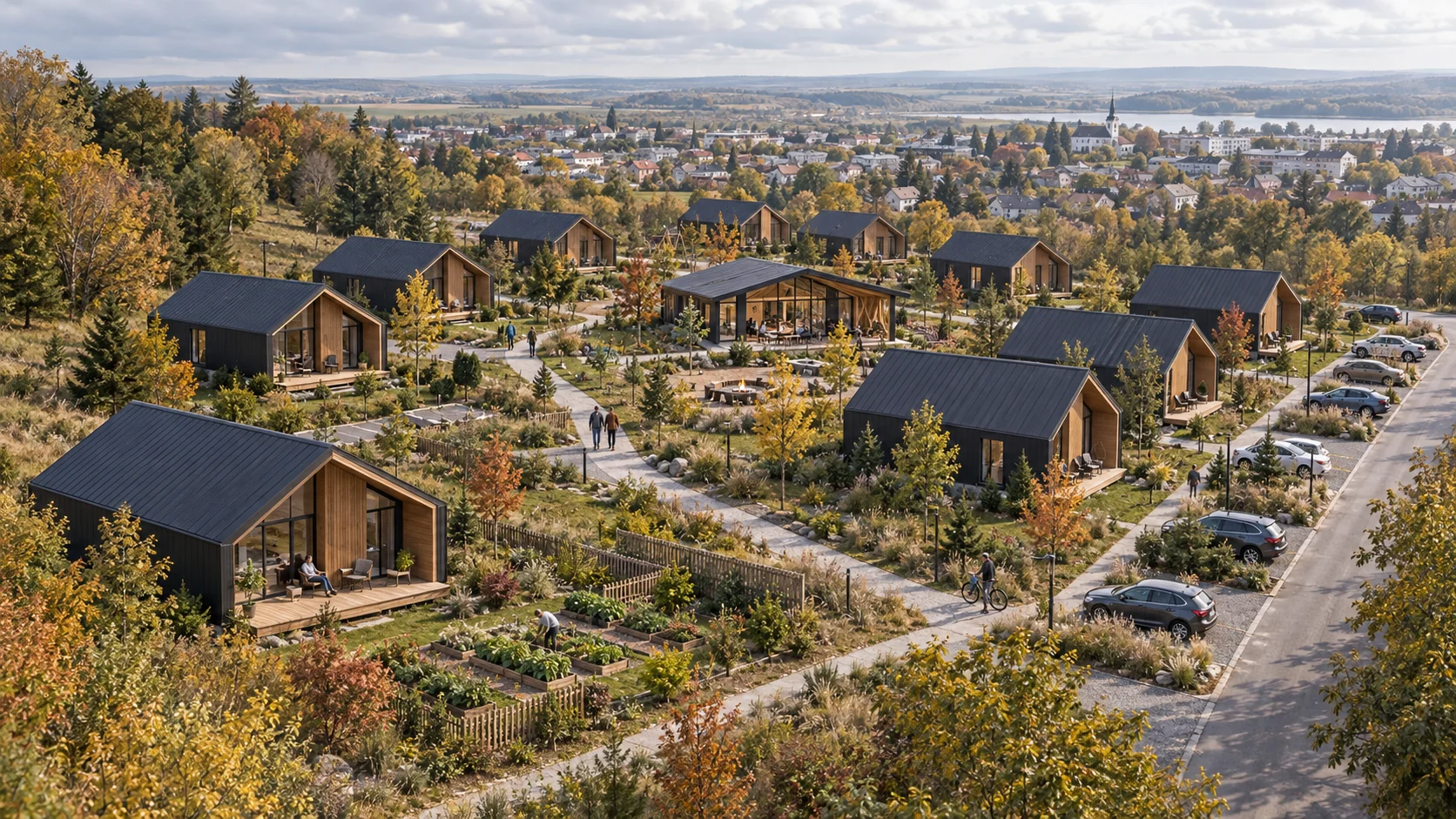
The Ukrainian project TYSHA presents a park in the Kyiv region, located 30 km from Kyiv along the Odesa highway according to its website. Its catalogue contains 18 home variants of 19–105 m²; the positioning combines forest-side living, shared quiet rules and organized upkeep.
The proposed model combines home purchase with the use of a 500 m² plot per home, without transferring land ownership. The website lists UAH 22,000 per month for infrastructure and services; electricity and gas consumption are charged separately. This is a local example of home ownership plus land use and recurring services, resembling land-lease, rather than a standalone home sale or tourist accommodation alone.
The 100 m² underground parking/shelter included in the stated home price is planned. Two months of autonomy is a design target still requiring calculations and testing. Reviewing the public offer does not establish actual occupancy, infrastructure readiness, capital raised or returns. This is an example of a Ukrainian format, not an announcement of a ModulDim partnership.
TYSHA · official website, reviewed 11 October 2026
InzhurPark · a woodland land-lease concept for permanent living
InzhurPark presents a managed woodland living concept 25 km from Kyiv, with access from the Odesa highway. Its website describes a 4.8 ha site and basic 21–28 m² modules. These are public concept specifications as of 14 October 2026, not an independent verification of the land or a completed community.
Model: home ownership, long-term land lease and recurring services. The land is intended to remain under the park's operational management, with shared oversight of the environment, community rules and architecture. The website also invites discussion of long-term home rental. These formats are not equivalent: land rent, service charges and whole-home rent need to be calculated separately.
| Advertised format | Module and land-use area | Offer rationale |
|---|---|---|
| Urban Escape · Drive Zone | 21 m² · 300–400 m² of land | Lower entry threshold and easy road access. |
| Balanced Living · Standard Loop | 21 / 28 m² · around 500 m² of land | A balance of privacy and proximity to shared spaces. |
| Deep Forest Retreat · Forest Premium | 28 m² · 600–800 m² of land | More space between homes and a location deeper in the woods. |
Energy is a planned layer. The concept includes solar generation, centralised storage, load balancing and readiness for a virtual power plant (VPP). The reviewed pages provide no generation capacity, storage capacity, test results or measured savings. VPP-ready therefore does not mean an operating VPP or proven energy independence.
Relevance to this study. Alongside TYSHA, this is another Ukrainian public offer resembling land-lease: a buyer chooses not only a home but also a managed environment with recurring payments. For a manufacturer, this is a potential B2B hypothesis; for an operator, it requires separate land, infrastructure and service economics. A landing page does not establish solvent demand, profitability or a ModulDim partnership.
InzhurPark · concept and formats, reviewed 14 October 2026InzhurPark · website rules and reservation limits, 14 October 2026
LEO STATES · charitable modular accommodation
The project lists two examples: Khorosno in Lviv region with 60 residential units and 200 places, and Bila Tserkva in Kyiv region with 10 units and 40 places. These demonstrate delivered organized accommodation. Free temporary housing does not establish commercial rental profitability.
ULIS · a commercial hospitality model
On its partner page, ULIS reports 80+ investors, UAH 44.37m in dividends paid for 2025, returns of 9–11% and occupancy above 70%. These are operator statements, not an independent audit or a guarantee for a new location. The return methodology requires separate diligence.
A partner builds the complex while ULIS provides concept, brand, launch support and operations. Scandi confirms that SCANDI 3 and 4 homes are used at ULIS in Dudky. This is a concrete Ukrainian example of a park as a manufacturer's B2B channel, but in tourism rather than permanent housing.
ULIS · partners · Scandi · ULIS
RE:Ukraine Housing · designing a living environment
The balbek bureau pilot envisaged a settlement for 15 families in Bucha district. It is useful for its approach to privacy and shared spaces. Completion of the whole pilot was not established from the reviewed sources; it is not evidence of an operating commercial park.
Which Ukrainian formats to test first
The priorities below are analytical judgments, not measured demand or an approved launch plan. No reliable nationwide estimate of Ukraine's commercial MHC segment was found in the reviewed sources; unknown does not mean zero.
| Format | Reason to test | Critical condition |
|---|---|---|
| Workforce housing | A specific employment location and potential anchor customer. | An employer agreement or another verified payer. |
| Long-term rental near a city | A ready home without buying land or managing construction. | Competitive total monthly cost and a workable commute. |
| Holiday park | Ukrainian commercial comparables exist. | Professional operations and credible low-season economics. |
| Owned home on leased land | Lower upfront outlay without purchasing land. | Secure tenure, transparent fee reviews, resale and financing. |
| Social housing settlement | Substantial housing recovery need. | Funding for ongoing operations, not just construction. |
Select land by employment, transport, services, legal status, utility costs and security profile, not minimum land price alone. Right-bank Kyiv region may be a test area, but each location must compete with apartments, townhouses and conventional homes.
War may increase displacement and housing need while reducing incomes, credit availability and willingness to invest. Continued war alone does not establish guaranteed commercial demand.
ModulDim: a manufacturing partner, not the entire park at once
The strongest initial hypothesis is supplying standardized homes to parks funded and developed by separate partners. The manufacturer owns home delivery and quality; the developer owns land, permits and utilities; the investor supplies project capital; the operator handles occupancy and maintenance. This is a proposition to test, not existing partnerships.
A batch order of similar models may reduce redesign, repeat purchasing and operations, and produce comparable installation, defect and energy data. This is where a future AI system could learn from repeated processes. Savings and impact must first be measured; the AI-native label does not prove them.
QHome case and capacity constraint
Five checks before a pilot
| Check | What must be established |
|---|---|
| 1. Payer | One primary model: household, employer, guest or donor. A verified payment mechanism. |
| 2. Full capital cost | Home, land, delivery, base, utilities, roads, landscaping, design, launch and contingency. |
| 3. Resident cost | Rent or loan, site fee, utilities, transport and required services versus real alternatives. |
| 4. Downside scenario | Slow occupancy, utility delays, repairs, arrears or a weak season. |
| 5. First winter | Actual energy, service and repair costs, not just presentation forecasts. |
Conclusion: global experience shows how factory-built homes can become a long-term residential or hospitality business. In Ukraine, prepared land and utilities, a payer and responsible operations are critical. A park may become a sales channel for a ModulDim product series, provided manufacturing capacity is separately secured.
Sources, date and research limits
Original review: 10 October 2026. Update on 11 October: the title “Prefab housing parks” and the Ukrainian TYSHA example. Update on 14 October: InzhurPark added as a Ukrainian land-lease concept, separating advertised specifications from verified readiness. Other market indicators have not been refreshed; measurement periods accompany the figures. Sources include government and regulatory documents, reports and transaction-party announcements; corporate statements are not labelled independent audits. The case selection is not a complete global market census.
Residential sites, homes, tourist nights, transaction volume and recovery needs are not combined into one TAM. Amounts retain their original currencies without implying comparability across years. Undisclosed prices are explicit. Recommendations for Ukraine are hypotheses, not investment guarantees or a newly approved strategy.
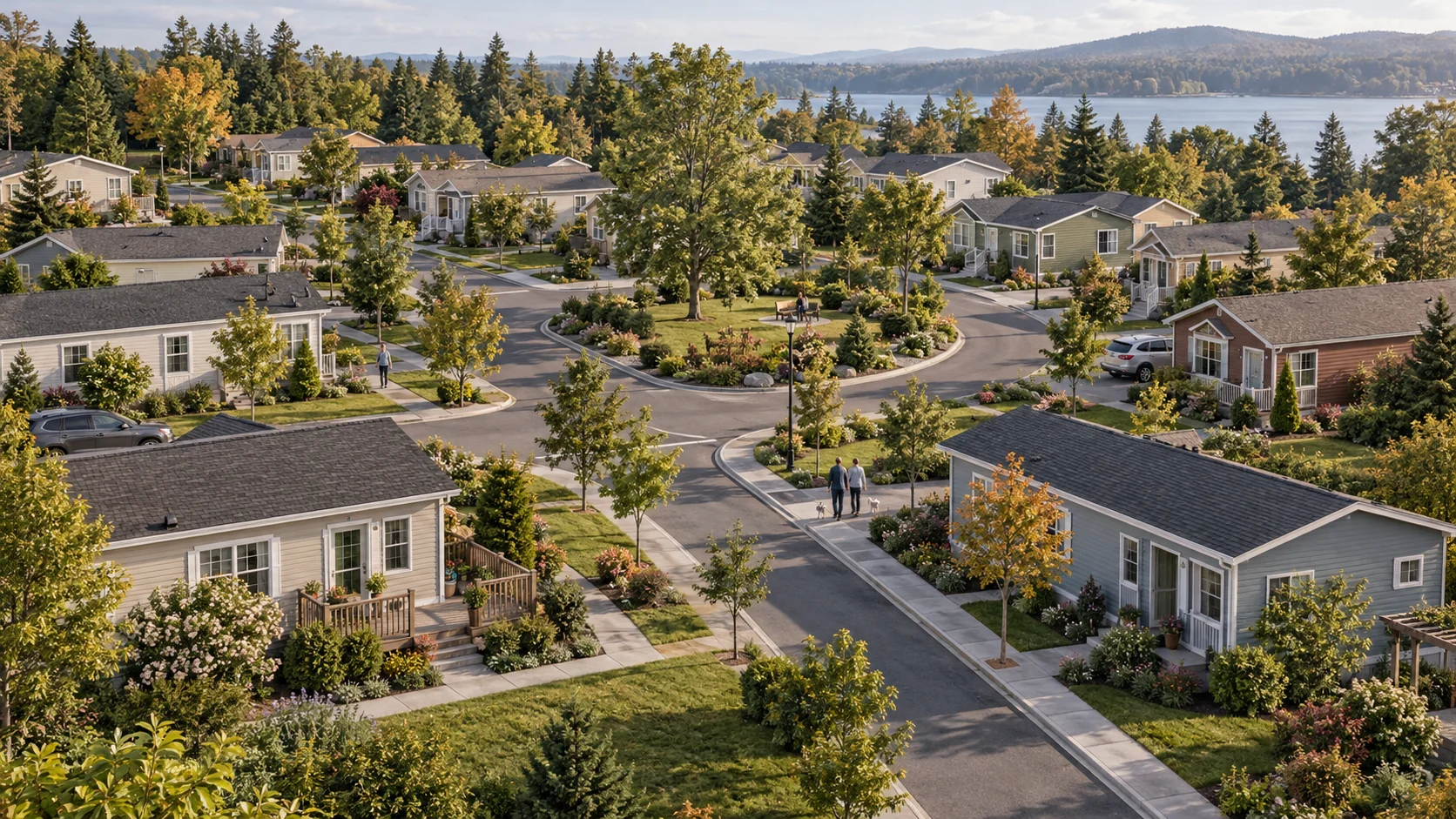
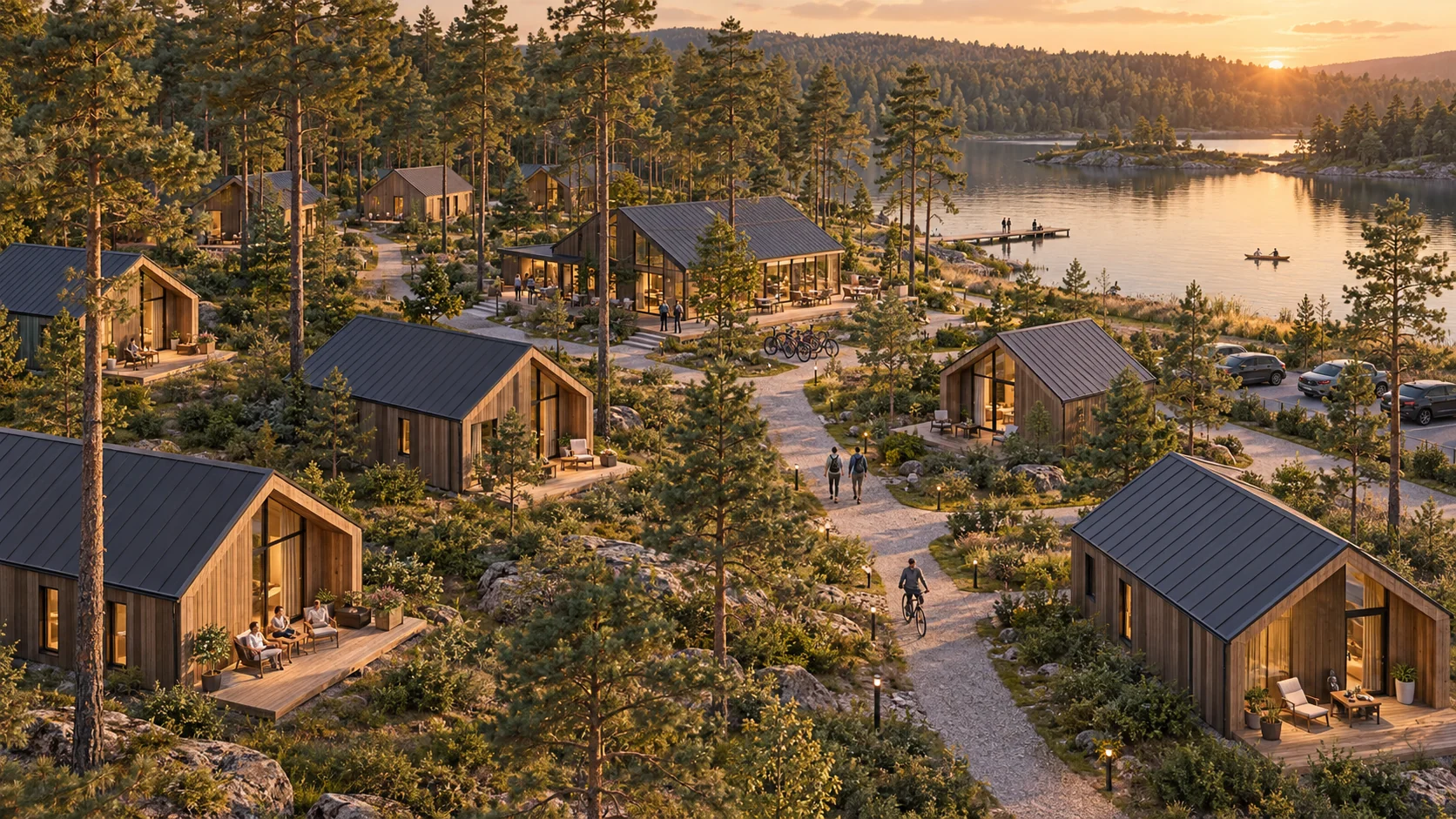
Three AI illustrations were created specifically for this article. They explain settlement typologies, not real investor assets, approved locations or operating ModulDim parks. Publishing this research does not open bookings or launch advertising or fundraising.
Parks · concept → · Project development → · Market and competitors →